26 May 2011

Memorial Day Weekend Madness!

If you're in or around the Bay Area this weekend, there are a few crucial events you won't want to miss! On Friday, Small Press Traffic presents the Inaugural Leslie Scalapino Memorial Lecture in Innovative Poetics, featuring poet/critic Joan Retallack. I'm printing a very complicated broadside to commemorate the occasion, and Joan's talk, "Poetry's Alterity," promises to be brilliant. Click the poster below for details:


AND THEN, Saturday night visiting poets CJ Martin and Julia Drescher join John Sakkis for what promises to be another essential Condensery reading. I've just finished printing Chris's first TWO books in one volume (fittingly titled Two Books), and we'll be launching the book at this event. Here's the info:

on Saturday May 28th

Doors at 7:30, reading will begin promptly at 8
Condensery takes place at:
604 56th at Shattuck
in Oakland
The reading is free.
Some wine and snacks will be served.
BYOB as always.
Street parking / porch for bikes.

And then something's happening on Sunday that I can't remember (anyone?), and then on Monday some of us are meeting to discuss Tiqqun's Theory of the Young Girl (email if you're interested!).

The weather promises to be beautiful, Lee Azus and Rob Halpern are back in town (yay!), and Chris and Julia are staying until Monday (I think...). I'm launching two seperate print projects, and I'll hopefully be done grading by then! Bring on the summer!

23 May 2011

ARTHUR ECHO


Here are the prefatory notes to CA Conrad and Thom Donovan's collaboration, Arthur Echo, a twelve hour somatic exercise recently released as a chapbook by Scary Topiary Press:

While house sitting for friends in Philadelphia we collaborated on the following (Soma)tic exercise, playing Arthur Russell's CD World of Echo on repeat on all five floors from 9am to 9pm, taking scheduled breaks for food, conversation, and checking in for further fine tuning of the (Soma)tic maneuvers.

BASEMENT: Windows covered, pitch black. On a little table covered with clothespins and pottery a small boom-box plays CD on repeat with bass controls set to maximum. A white candle to light when sitting down, blow out when leaving. The sink beside the table to slowly drip water on one hand while taking notes with the other.

FIRST FLOOR: CD on stereo with balanced equalizer settings. All shades open. A chair sits by the front door. Open mail slot to peer at passing feet on the sidewalk. Every other page of notes should be nouns only, a page of nouns.

SECOND FLOOR: CD on small stereo, volume low. Computer set to show videos of Arthur Russell and his cello. In bathroom the tub is filled with a mixture of water and jasmine flower infusion. Jasmine invokes the Muses. Take notes sitting in a chair by the tub while feet soak in the jasmine infusion.

THIRD FLOOR: CD on large stereo, volume high, treble adjusted to maximum. Books on alchemy sit at the desk by the window. Take notes.

UPPER LOFT: CD on third floor stereo carries up to the loft. At the end of the bed, facing the window which looks over the Philadelphia treetops and skyline. There are tarot cards and binoculars on the bed to better see the world. Take many notes.

_____

The results?

Here's Conrad:

we are selective with love
but I think it's because
there's only so much
does anger have the same amount per
square mile for water-drinking people?
I'm glad we're friends
space can be divided by
popsickle sticks or
pyramids in Mexico where
enemies didn't want to bleed but
bled anyway
sometimes I cannot believe
how delicate tendons
muscles and bones are thrown
crackling into oil
are chickens enemies?

And Donovan:

To a fugue soft 'to-be' languageless though he
was Helen Keller's water another's cats pass
Through experiential filters happy endings for
If the voice of human beings is received by hear
ing the voice of God is received by sight con-

comitant to this act of existing the temple
Will not be destroyed rock salt vs. sea pseudo-
Selves grieve I let my attention wander with
The bow when my eyes cease to focus and
When the ears cease to focus and when the

Mind ceases so that we must see each collation
Of bodies a blind-spot or blank embodying ide-
ology my thoughts will have been here before mis-
takinng static for running water sister-flicker in
Place of substance what instance liberty coracle

20 May 2011

The Reliquarium: This Saturday!


It's finally happening! The Reliquarium, that is, and hopefully not the end of the world. Though the Reliquarium does sport an apocalyptic theme this year in light of the Doomsday predictions. According to Harold Camping, it's supposed to be an earthquake, so I called to check on our earthquake insurance and now I'm ready to party.

While the Reliquarium is a fundraiser for SPT, we're also considering it an end of season poetry party, so come out and mingle and have fun and enjoy the end of the semester (if you teach or learn!). Let's see: literary timecapsule? Check. End times dance party? Check. Reenactments from the end of the world? Check. And, the main event: an auction of reliquaries from such luminaries as Charles Bernstein, Rachel Blau DuPlessis, Kathleen Fraser, Bob Gluck, Nathanial Mackey, Harryette Mullen, Eileen Myles, Camille Roy, Tyrone Williams, and many others. 

And it's a pretty quite poetry weekend, so you don't have an excuse. It all goes down this Saturday (May 21st) in the CCA Grad Writing Lounge (195 de haro Street, SF) at 7:30 pm. Come out and support one of your crucial local resources while catching up with long lost friends!

19 May 2011

A Reading: Birds


This impeccably produced new chapbook by Beverly Dahlen inaugurates Little Red Leaves "textile series": chapbooks "lovingly sewn using recycled curtains and other textile remnants." I can't get over how beautifully constructed these books are, and because we're rarely treated to new work by Dahlen it feels like a real event. I'm told this chapbook is already sold out, but there's a second edition on the horizon, so keep yr. eyes peeled!

Here's Beverly:

"The greater white-fronted goose in that fair field, geese,
more than a thousand in the flock moaning, a kind of low
hum, singing the blues. The spectacle of the birds, how we
go out to see them now, provide for them, shelters, refuges,
how we've beggared them and set them aside amid the low-
lands of the valley, the trucks roaring night and day over I5,
San Diego to Sacramento, ripping up the countryside.

Sacramento to Redding to the Oregon Border:

above Keeping Still, Mountain
below The Abysmal, Water

the very place, we say, tearing at the air."

There's so much going on over at Little Red Leaves it's often difficult to keep up: Here you'll find information about the "Textile Series," here's the magazine (issue #6 is on the way? all ephemeral publications? and E-BOOKS too!) and here's the blog (which seems to be the main news outlet?).

ESSENTIAL.

18 May 2011

Albon on Albion


There are few things in this world more exciting (at least to me!) than a favorite poet releasing a new chapbook on a favorite press. Just received this in the mail: George Albon's "Ryman Room" on Brian Teare's impeccable Albion Books. Teare printed the cover blind on white stock, so it's almost impossible to get the scanner to pick up the nuance. But you can see a couple of good shots here.

I shouldn't have to convince folks paying attention that this is totally essential, but I wanted to leave two little hints as to why:

"I was thinking about the word absolute and I was trying to get at the meaning of it. It had to do with painting also." Robert Ryman

"I will jump from the not-gap I'm on to the not-gap I want. It bends from a little wait, then forms to sudden. The way will be found by finger and wrist, the curds already traced in the window." George Albon

Click the image below for samples:


DON'T SLEEP.

16 May 2011

More False Intimacy


In his interview with Erika Staiti, Whitener reimagines the labor of "manifesto" as the positive articulation of what's least known in one's work: the declaration of blind spots or short-sightedness or rigid thinking or a crucial lack of imagination:

"What I most responded to in your question are the words modulate, corporeal, and crises. I would shy away from Manifesto, especially with a capital; I think the work is trying to draw new lines between the manifest and the latent, or the material and the immaterial. Manifesto also implies perhaps a program or a knowledge: perhaps this book is a negative space of a manifesto, sites of passage out of unknowing and unbeing, or rather its form is a search for sites (linguistic, formal, conceptual) where gestures or skins or subjectivities could be hastily thrown up...The piece's response is to modulate, to set up altered linguistic zones and conceptual figures that could possibly bind together a skin (in turns animated by colorlessness, the feminine, etc.) but skin that involutes 'material' and 'immaterial' in unique ways or a skin that might also just be exits..."

I've been trying to understand False Intimacy through a claim in Tiqqun's Introduction to Civil War about "community": "Community never refers to a collection of bodies conceived independently of their world. It refers to the nature of the relations between these bodies and between these bodies and their world. The moment community tries to incarnate itself in an insolatable subject, in a distinct, separate reality, the moment it tries to materialize the separation between what is inside and what is outside, it confronts its own impossibility. This point of impossibility is communion. In communion, the complete self-presence of the community coincides with the dissipation of all community within singular relations, and therefore coincides with its tangible absence."

Maybe the impossibility of communion (or community as the point of impossibility) stems from the subject's troubled relationship with the contemporary (or contemporaneity)? So that the community fades in the articulation of "singular relations" that are themselves afterimages of false intimacy? I'm reminded here of Agamben's claim in "What is the Contemporary": "Contemporariness is, then, a singular relationship with one's own time, which adheres to it and, at the same time, keeps a distance from it...Those who coincide too well with the epoch, those who are perfectly tied to it in every respect, are not contemporaries, precisely because they do not manage to see it; they are not able to firmly hold their gaze on it." And later: "The contemporary is he who firmly holds his gaze on his own time so as to perceive not its light but rather its darkness."

Whitener investigates a time one "cannot manage to see" (the 90s) through the lens of a subjectivity one does not fully "occupy," troubling the notion of a unified community embodying an "insolatable subject" so deeply related to the time of its own mis-understanding:

a hollow shaft of negative space
running straight upwards and
through bending itself into a
pulsing gucci symbol, unslung
up towards hong kong, doubling
back inside itself, sounding,
becoming not large but more
interlaced, the 1990s, America,
visible, nodding, rapid multiplier
effect, reduced into consumable
prey, i can open my mouth and
it will pummel, a figure tracing
an arc from an optic nerve to a
hole, tracing a certain
instantiation of whatever was
given and then again and then
again, like an exit, look, it's fine
if you are more beautiful than i
am, plastic surgery is the new
ruin, it's THE 1990s, narrative
is not enough, and if we just
spin these pronouns around fast
enough, we could create a
given, i mean, a body, for us, a
problematic pirated body, that is
what breaks from within the,
neither furry nor plastic, neither
nodal nor oddly enough, my
beautiful given, the negative
space of a desire, a shaft,
adorned in gucci

let's not start thinking

Tragedy
depends not on the events, but
on the
environment

language that has abstracted
itself from pronouns a
photograph of a specific
historical occurrence whose
description taught us something
about the body and language we
nodded together, spammed, what
WE WERE DESTINED TO
CREATE blankly, a flat plastic
spur, faux, of an unprecedented
space abstracted from pronouns,
spun and nodded

_____


False intimacy with the present begins with our understanding of the contemporary; Whitener illustrates how we might reimagine the present by tracking, isolating and undercutting those moments we feel most confident we belong to it. Rather than occupy an impossible communion peopled by static, rigid bodies overdetermined by their moment, Whitener proposes a community founded on unknowing one's place and time as a mode of belonging.


11 May 2011

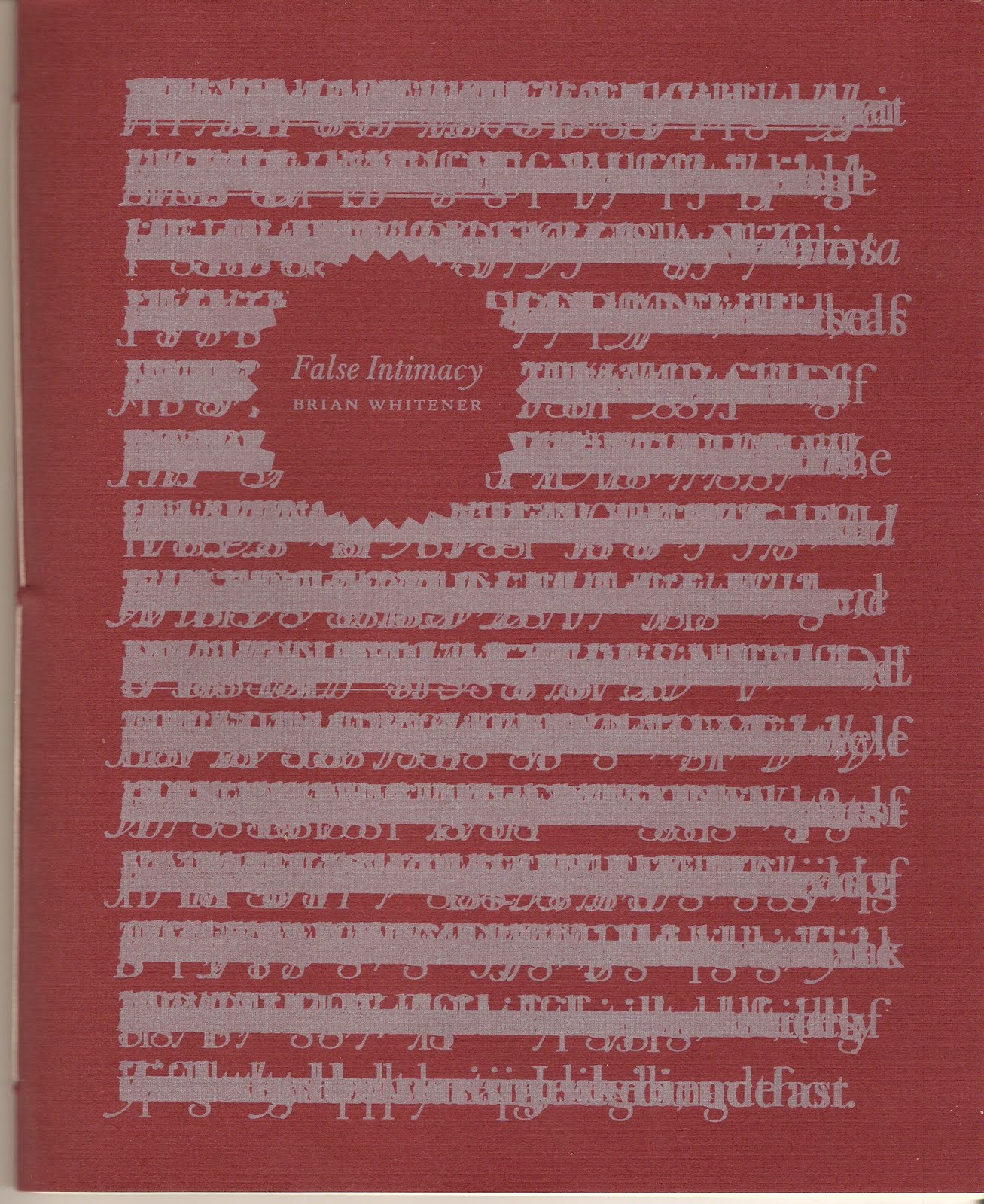
Brian Whitener's False Intimacy


The longer I've lived with Brian Whitener's False Intimacy, recently published by the East Bay's own Trafficker Press, the more I've felt really profoundly moved by it. Since picking up a copy at the Osman, Whitener, Rees event at SPT, the book's occupied a permanent place in my bag, which has offered the opportunity to read and re-read it in some of the most unlikely of places. Brian and I had a great talk about the book during his visit in early April: how those things we imagine experiencing super intimately are the very things from which we are often most abstracted—so that our insistence on (or assurance of) intimacy becomes the very blindspot that helps distance us from our own experience.

Here's Brian from his interview with Erika Staiti (worth the price of admission alone): "This book...emerges out of a kind of obsession I have with 'the 90s'...It's the period where I most feel like a stranger to whatever I am now. But I have been wondering if perhaps this is a structural and not personal condition, that is an effect of a return to US imperialism...In that way 'tragedy' has effects that register as both spatial and temporal, and these gaps or 'insurmountable breaks' give rise to forms of false intimacy, ways of attempting to live the abstractions of the sublime gaps of tragedy-thinking..."

I've read this book a handful of times and realize only now that it works for me as its own kind of false intimacy: everytime I think I've pinned it down (or at least have developed some robust reading strategies!), I find myself rethinking what it means to experience writing "intimately."

Here's a section from the first movement:

daily
popular pedagogy: i can't
explain the x in that word
because it's too involved
with what we were trying to exchange.

life during money

I know
my body is without value, how could 
you inform us of this
valuelessness, how does it.
There is no war. There
is not such a thing as war. What is
war? a rehearsal of conditions
What is war but a transgression,
and what is transgression but
the unexamined influence of
capital on my desire(s). There is
no war, a rehearsal not an
identification because there is
no history, because there is no
history because there is no war,
social, socially, socially my
thinking became invested, which
I could only think in relation to
a future, that is, spatially, 
spatially inverted structures that
have been inverted, but failure
is also failure if only thinking
were enough, that this point
probably means more
less post...but I...
what
one means is that the body is
without value
is a shift in perspective, which is
a
spatial metaphor
change as
seen then
from under
determined future(s)
question mark...

Even now, I'm reading this poem way differently than I have been these past few weeks, and I think this might have something to do with the size of the font. The font is really, really big in the book (like reading a Word document at 200%)—"to push the language...into becoming an image"—which I'm starting to think has contributed to my vastly different readings in terms of speed and attention, but also in terms of what I take with me into the world. Typing these lines now, I'm much more aware of these macro-syntactic structures I couldn't "see" otherwise, whereas before I read in short phrases as they presented themselves. The large font creates a sort of shortsitedness in that the reader can't preview the text to come in an effort to learn how to read it. So one's left reading kind of blindly—that is, reading only what's right in front of you, perhaps in the way we "read" time.

"to what degree you can only
enter so far wanted to create a
new type of experience how did
it get so fragile a kind of body a
kind of abstraction that could
live inside another body a body
that could unveil itself without
argument, without recourse to
language REPRESENT ME in
the past year a shading of a
temporal element the familiar
abstraction..."

I love this notion of a very bodily present-experience of having lived in the past somehow "elsewhere," always elsewhere...certainly in the same body (or at least a version of it) but above it or beside it or literally in it, but a different body in that body. A present experience of a past experience that feels so much less embodied, which might serve to remind us that the present will have proved disembodied in the very same way, even as we live it.

10 May 2011

Also, THE RELIQUARIUM


I should also mention that this year's Reliquarium is right around the corner, and it promises to be really, really fun! This season's event takes place on Friday, May 21st, which happens to also be the end of the world (according to the many eschatological billboards popping up around the Bay Area! Many now feature a big gold stamp that reads "The Bible Guarantees It!"). As such, we plan to go out with a bang! Activities include an end-times dance party, reenactments of scenes from the end of the world, and a literary time capsule (which we might be burying in David Buuck's backyard?!). And I promise to personally ensure that whatever beverage we serve will not be the weird-tasting punch we served at Poet's Theater!

But the real attraction is the auction of reliquaries "representing the artistic DNA of the smart and famous." Writers and artists of all stripes have banded together to donate relics that represent their practice in a substantial way, and we'll auction these one-of-a-kind rarities to benefit Small Press Traffic! The relics are starting to arrive at SPT Central as we speak, and it's way interesting to see how folks represent their practice. The list of contributors alone is pretty impressive: Steve Benson, Charles Bernstein, Julian Brolaski, Rachel Blau DuPlessis, Enrique Chagoya, Thom Donovan, Elaine Equi, Coco and Rob Fitterman, Kim Rosenfield, Kathleen Fraser, Bob Gluck, Judith Goldman, Tracy Grinnell, Nina Katchadorian, Kevin Killian, Joanne Kyger, Nathaniel Mackey, Harryette Mullen, Eileen Myles, Sina Queyras, Ariana Reines, Larry Rinder, Camille Roy, Kaia Sand, Fiona Templeton, Edwin Torres, Tyrone Williams, etc. etc.! Pretty for real, no doubt...

And while we'll be accepting bids through SPT's website, it's one of those feel-good, end of season, almost summer, school's out, nothing better to do sort of events that are most fun to experience in person. And if it turns out it really is the end of the world, at least we'll be together! Mark yr. calendars...

THE RELIQUARIUM
Saturday, May 21st, 7:30 pm
CCA Graduate Writing Lounge
195 deHaro Street, San Francisco

09 May 2011

The First Annual Leslie Scalapino Memorial Lecture in Innovative Poetics


I am very pleased to announce that the First Annual Leslie Scalapino Memorial Lecture in Innovative Poetics will take place on Friday, May 27th at Timkin Hall, and we at Small Press Traffic are deeply honored to welcome Joan Retallack as its first presenter! The Leslie Scalapino Memorial Lecture in Innovative Poetics is an annual lecture series with a focus on critical analysis of innovative poetry, essays, plays and cross-genre work primarily by women poets. The series invites contemporary writers to present their work in the spirit exemplified by Scalapino’s own critical writing and editorial vision as publisher of O Books.

In anticipation of Joan's visit I've been rereading her rich body of work with relish, starting with Errata 5uite (Edge Books, 1993) and Afterrimages (Wesleyan, 1995) and slowly making my way to newer work like Memnoir (Post Apollo, 2004) and Procedural Elegies / Western Civ Cont'd (Roof, 2010). I'm also diving into her interviews with John Cage (her questions alone make the text an intriguing read: "Do we need an art that is not identical with the things that surround us in everyday life, but can somehow draw our attention to them?") and her essays in The Poethical Wager. I'll post notes here as I slowly piece together an introduction for her talk. In the meantime, here's my favorite poem from How to Do Things With Words (Sun & Moon, 1998), "Here's Looking at You Francis Bacon" (click the arrow in the top-right corner for full screen).

">

Please help us spread the word about this crucial new lecture series!

The First Annual Leslie Scalapino Memorial Lecture
in Innovative Poetics
Featuring Joan Retallack
Friday, May 27th, 7:30 PM
Timkin Hall at CCA
1111 8th Street
San Francisco, CA 94107
Admission: $8-15 (Members Free)
 
And while we're on the subject, please take a moment to check out the beautiful new website devoted to Leslie's life and work!

06 May 2011

RAGTAG / TRY / WITH+STAND


New work by David Brazil, Sara Larsen, and Alana Siegel in (new to me) RAGTAG #3 (published by Monica Peck). Samples below...


And while we're on the subject, Brazil y SLRSN just released a new TRY with tons of great stuff by Ted Rees, Owen Hill, Rodney Koeneke, Catherine Meng, Lynn Burnett, Rosemary Griggs, and many others. A crucial local resource...


And finally, here's Brazil really wonderful piece in the new WITH+STAND (click the arrow in the top-right corner for full-screen)

">

05 May 2011

More WITH+STAND & Launch Party!


More highlights from Dan Thomas-Glass's essential insurgent dispatch, WITH+STAND! Before I dive in to the wealth of interesting material, I wanted to mention that the launch party is scheduled for Friday, May 13th at Zughaus Gallery (1306 3rd St., Berkeley // 7-11 pm), so mark your calendars! The line-up's pretty stellar, to say the very least: Jackqueline Frost, Barbara Claire Freeman, Lauren Levin, Meg Day, Monica Peck, Kristin Palm, Lara Durback, Erica Lewis, Brian Ang, Dan Thomas-Glass, Jennifer Karmin, Erin Wilson, and others. Don't miss...

As to highlights, check out this fantastic piece from Suzanne Stein:

December 28, 2010
Mike Hauser

Hi Mike,

• anxiety
• avoidant behavior (procrastination)
• food obsession (repressed/suppressed)
• body obsession (foregrounded)
• knowledge/information obsession and rejection (reject the real means of satisfying the need, the desire—often by procrastination)
• worry about sexuality/orientation and desire (surface level, a borrowed concern, mother's, belief in it as the mother's)
• worry about cleanliness, bodily and environmental, avoid solving the problem but continue to carry concern about it, then obsessive attention/energy attached to it
• hatred of others, outweighing feelings of love/affection
• mistrust of others, outweighing feelings of acceptance/affection
• fantasy lovers, attached to real people
• superiority complex (often masquerading as inferiority complex)
• social anxiety—repetitive thoughts of inadequacy in social interactions
• abjection or barely conscious (coming to consciousness) abject behavior—partly manifest in caveating, forms of apologizing (for self, for existence)
• obsession with other women's bodies, making comparisons
• incessant grooming behavior, excessive obsession with grooming compulsions, like face-picking, nose-picking
• combined with some forms of body avoidance: ignoring/overlooking/blindness
• hatred of/critical internal dialogue about/ body, face, hair, nails, breasts—worse as growing older, but occasionally better, marked by acceptance
(*capitulation/relief)
• attachment to unavailable ('dead') objects
• hypochondria
• anxiety attacks, often attached to hypochondriac fantasies, especially related to fear of poisoning, fear of allergic reactions, that is, fear of having ingested (taken in) something that will kill me
• superstitious behaviors
• talismans, touchstones, rituals
• the feeling that the rituals are halfheartedly or improperly undertaken
• the feeling that almost all things are improperly undertaken/poorly performed
• inability to objectively judge (my own production/issue)
• pride in shit
• exhibitionism, mild, moderate to severe, sometimes repressed awareness of
• displacement of thoughts towards fantasy others
• worry about being seen/assumption of being seen (belief in god, belief in
omniscient others)
• compulsive/impulsive spending
• forgetting to 'take care of business'—pay bills, manage life details
• guilt

• belief in the sublime
• magical thinking
• love of enchantment
• shame, especially attached to lack of knowledge

Warmly,
Suzanne
_____

Andrew Rippeon's short stanzas from FLIGHTS are characteristically careful and compelling, but I was particularly moved by the following (printed in the journal on separate pages):

the hill I am of
ashes hence my father’s
son I am no song my
father’s name adrift a boat
upon waters the color of
the moon…

if ocean’s edge a
falls remembered sound of
pebbles’ wash the portes open
the gates from the hinges
this
empty terror houses rent
up and burnt

_____

Brian Ang's piece for Taylor Brady is appropriately relentless! Here's a little taste:

Ghostlike name passing on night ground
dizzy division pleasure can’t remember
gradient of change in multitude of time
like a tower plaited with difference
falling forever one memory abandons

Parsed beginnings one and one is one
injunction that burns the dispersion

Constellation on fire already historical
displaced interior shaped like a sentence
one awakend ány nowhere known some
assembled power loved back beauty
_____

I really loved the following piece from Vancouver's Stephen Collis (who I had the pleasure of reading with in Buffalo way back in 2003?). Reprinted here in full:

SOME HIDDEN SWITCH OR LEVER

It’s simple to effect
the light just stand
between this page and
the sun or turn

scientist and calculate the
years until we go
supernova the firey ball
expanding to curl our

planet like paper in
the fire after all
you say how long
can we expect to

simply hang around doing
nothing much at all
stocks going up and
down sites endlessly surfed

all the while I’d
been imagining there was
some hidden switch or
lever tucked away someplace

we could perhaps having
looked long and hard
find and simply throw
into the “off” position

then we could sit
back and watch the
world go back to
(or maybe ahead to)

what it could be
swallow throats and gulfs
if we weren’t so
hell-bent on killing ourselves

What do you call
this you ask I
say change we can
effect change we can

make you say I
should get out of
your light the sun
now warming the page
_____

And just to nail the point home (that is, that you need this issue!), here's a final word from Lara Durback: some prose blocks from her piece "Hoarders, And Those Resembling Hoarders":

-We are diviners. When I think so much about this show called Hoarders, it will eventually (no, rather quickly) cause my mother to come around with a bin of my things. It is a plastic bin so big that two of me could fit in there. It is a double coffin and a time capsule. I dig through rave flyers one by one on my aunt's couch and think about how my life was saved. I puzzle over the gloves and sweaters I thought I would never need in Northern California. I touch individually each one of Grandma's crocheted Barbie dresses. Her hands must have moved so often.

-I saw the woman on the show Hoarders sit down in the chair, unable to deal with her accumulation of dolls. The host person, a psychologist or professional organizer, or whoever was there that day, dives into the room of dolls like it is a pit of foam. I want to do that thing.

02 May 2011

Heidelberg Comes Home!

What these pictures don't show is the triumphant (and anxiety-producing) moment between the last two photos (that is, the press leaving the forklift at the bottom of the drive to rest snuggly in the garage!), and for good reason: once we realized the forklift couldn't make it up the driveway with the press in tow, we put the press on a hydraulic lift, attached two 8' 4x6's to the forklift, and PUSHED the press up the driveway with the forklift by pushing the forklift up the driveway with a flatbed truck! So here's the order of operations: truck pushing forklift pushing 4x6's pushing hydraulic jack pushing Heidelberg up the driveway with me at the top trying in vain to steer the jack (which is why I couldn't take a picture!). It's a travesty that this image survives only in my mind, because it was pretty epic!

29 April 2011

Rob Halpern on "Somatics"


Here's Rob Halpern's response to Thom Donovan's "Somatics" questionnaire, originally published over at Harriet (reprinted here for a "local audience"!).

Essential reading, no doubt, and delivered on the weekend so you have plenty of time to chew!

Here's Rob:

Shortly after the “Movement, Somatics, and Writing” Symposium in Ann Arbor in February 2011, Thom Donovan asked me to respond to the following questions on somatics, poetry, biopolitics, and affect:

1. What, if anything, does the term "somatics" mean to you, and how might you relate it to your work?

To be honest, Thom, I don’t know what “somatics” means. And if “somatics” means something to me and my work, this can only be because it has some collective resonance, if only as a provisional frame of loose reference for investigating the relationships between body, language, and social space. Somatics seems to be about working collaboratively in a range of areas to link very different practices by way of some shared concerns around embodiment: from poetics to choreography, psycho-geography to homeopathy, body work to translation, community history to political militancy. I’m thinking here of CA Conrad’s somatic exercises, Daria Fain and Robert Kocik’s Phoneme Choir, as well as Kocik’s architectural research for a Prosody Building in Brooklyn; or Eleni Stecopoulos’s poetics of healing and Brandon Brown’s embodied translations; and I’m also thinking about David Buuck’s performance research in duration, Brenda Ijima’s site specific dance improvs, and David Wolach’s militant patiency, among many others. Crucial literary antecedents for my own approach would stretch from Whitman’s Drum-Taps to Genet’s Funeral Rites; and from William Burroughs’s The Wild Boys, to Robert Glück’s Jack the Modernist, Dodie Bellamy’s Cunt-Ups, and Kathy Acker’s Great Expectations (which includes her translations of Pierre Guyotat’s Tombeau pour cinq cent mille soldats).

It might be worth mentioning that when “somatics” came up as a point of focus in the Nonsite Collective—where we try to sustain discussion and collaboration across disciplined divisions of culture work—we were simply trying to find a way of addressing embodied dis-ability and social dys-function, specifically in relation to various language practices, without taking a free ride on terms already in circulation around “disability studies.” An important exchange between Amber Dipietra and Eleni Stecopoulos was critical. (The Nonsite discussion around somatics, disablement, and aesthetic practice, including this exchange, is archived here.)

But now that I’m thinking about it—and this may begin to get at something more meaningful regarding my own work—“somatics” might be no more than a placeholder for this desire to return the body to social/aesthetic practice where it seems to have disappeared despite its apparent self-evidence, despite its false immediacy as some sort of phenomenological plenitude; that is, to return the body, if only as a question or a problem or a conduit of social sense, to scenes of engagement where it seems to have gone missing, despite our recourse to words like “the body,” which may have hemorrhaged its living content and become an abstraction of the very thing we want to believe is most concrete and inalienable. I’d like to think of “somatics” as taking aim at some of these problems.

So much has been made of “the body,” and yet it feels as though it’s always about to become a bland fetish, a hygienic fixture, an allegorical trope, rather than a set of messy stakes and real consequences. Brian Whitener and I were talking about this on Sunday afternoon at the Somatics Symposium. What is not being talked about when we talk about “the body”? Whose body? Can it ever be definite? Can it ever be singular? Brian was referring to false intimacy, and the porousness of skin, and I was thinking about our vulnerability to penetration—be it by flesh, prosthetic, or bullet—and an unsettling line at the limit of Music for Porn: “My cock hardens in a soldier’s wound.”

Brian and I were also thinking about the importance of social movements that have enabled us to imagine “the body” as a critical obstruction in social space, not as a transparency, but as something opaque and resistant. Civil Rights. Feminism. Gay Lib. I’m thinking here, on the one hand, of a line from MLK’s Letter that you often refer to, Thom: “As in so many past experiences, our hopes had been blasted, and the shadow of deep disappointment settled upon us. We had no alternative except to prepare for direct action, whereby we would present our very bodies as a means of laying our case before the conscience of the local and the national community.” But I would also draw attention to work by gay New Narrative writer Bruce Boone, whose Century of Clouds insists on the body as a location of radical praxis: “My sense of community began to take on the limitations of real bodies.” This is a body whose subjectivity is a function of “the always immanent possibility of disaster, a peril that implicates each of [the community’s] speakers collectively as a disaster common to all” (Boone). The performance art of Adrian Piper, Carolee Schneemann, and Marina Abramović, among others, seems crucial to mention here, too.

As for my own work, I’m interested in the way an intractable body—a body resistant to social apparatuses that would harness it to ends not its own—nevertheless gets caught up in processes of militarization that often escape perception, despite those processes having shaped our environments. Music for Porn gets totally obsessed with this. Current conditions are so unbelievably bad, and I want to locate the writing in the cleavages and faults where my body collides with these conditions, and where the poems become sensory organs in the process of perceiving them. We’re all longing to find a way beyond the current crisis, as if our sense of normality were not itself a state of crisis, and we encounter nothing but blockages and impasses: both materially, politically, and affectively. The obsessively recurrent figure of the masculine soldier in my recent work marks an obstruction in sense as the poems struggle to imagine what a demilitarized world might feel like. The most despairing result of my investigation has been that this can’t even be imagined, and my soldier’s hard muscle concentrates and allegorizes one of the obstacles. But there’s also a hazy eros permeating the soldier’s appearance. My body channels so many contradictory feelings and affects around this eros—rage, longing, sorrow, shame, anxiety—as the soldier becomes an object of violence and lust. I’m hung-up on him. The poem wants to kill that soldier for standing in the way of a demilitarized future; but the poem also wants to be fucked by him because the repressive sublimation of whatever eros clinging to his body has become unbearable just as the realization that I, too, stand in the way of that other future has become unbearable. These may be amplifications of subcutaneous feelings that the writing senses beneath our social skin. But for me what’s important is the way the poem is able to make these contradictory affects audible, as if for the first time. Are they potent or impotent? My poems seem to want to arouse this affective material—what can it do?—at a moment before it hardens around familiar social feelings that can be made useful in ways that lubricate the reproduction of our stupid militarized machine.

I guess what I want to ask is, how might our work as artists, writers, or teachers probe the submerged relations between our bodies and the social forces that channel their potential? How is the fate of my body intimately linked to the fate of other bodies we’ve failed to recognize, bodies our frames of reference can’t even admit, bodies lost in scenes of global conflict and other social occlusions: be it a dead child in Gaza, or even a dead U.S. soldier (insofar as images of their corpses are withdrawn from circulation)? And how might a poem reconfigure these frames and the embodied relations that fail to appear within them?

So I’m thinking about how something called “somatics” might help us address the fate of our geopoliticized bodies by elaborating a set of practices for investigating, thru physical, aesthetic, and linguistic experiment, the relation between language, body, and social space in order to activate and organize sensation against the grain of a dominant common sense.

2. To what extent does your work relate to the Spinozan proposition: "we have not yet determined what a body can do" as a kind of slogan for bioethics and –politics. In much of your work, I think that you are addressing biopolitics as a way we have come to see (or been forced to conceive) of the contemporary subject. Could you comment on the role of this discourse in your work?

I want to take Spinoza’s proposition seriously, but it becomes a useless diversion — or even an apology— if it’s not guided by the realization that we do know what has been done to bodies. I mean, what is being done to them now?

Maybe the passively voiced question, “what is being done to bodies?”—together with our potential resistance to that—helps get at what you are referring to, Thom, as the “biopolitical” in my work? And I’m thinking here not only of incarcerated bodies, but our own bodies as well. What is being done to them? It’s a question that complements the question What is to be done? For me, to think this question requires a shift from an emphasis on an over-valued notion of agency toward a very different idea I call patiency, which has less to do with the body as the sovereign scene of its own actions, and rather with the body as scene of disabused sovereignty. Patiency refers to the suspension of our proprietary relations to our and others’ bodies and life processes, the recognition, and perhaps even the affirmation, of the corpus as open, disarmed, and vulnerable. I want to find in this figure of the patient not only passivity and submission, but the latent material—affective, erotic, and social—for movement just waiting to be aroused by uncoded sound and unanticipated touch. Maybe this is “somatics”?

This idea of the patient body helps me rethink “my body” not as a self-enclosed and self-evident fact, but rather as a social process—or a convergence processes— extending in time and space, in excess of my skin and skeleton, my orgasms and DNA, and always becoming part of larger assemblages together with other bodies both locally and trans-locally, sometimes in zones that seem very far away. Moreover, patiency challenges the delusion of mastery over our own body’s borders, a delusion that often converges, both semantically and materially, with a policing function.

While thematizing these conflicts in sense, my writing in Music for Porn lends perceptible form to the militarization of our intimate longings. At least this is how I’ve come to read one thing the poems seem to be doing. What comes to mind here as being most pressing concerns the way in which my own well-being—the integrity, the pleasures, and satisfaction of my body—depends on others’ losses, an incommensurate vulnerability, an unevenly distributed and unshared exposure to geopolitical violence: so many disavowed intimacies. How might a poem register “intimacies” for which there exists no proper discourse? How might an artwork interrupt the ease—because unthought—with which one body buries or eclipses another body in geopolitical space where a militarized imposition of democracy and the “management of populations”—i.e., biopower—holds sway? I guess I’m wondering what a poem might sound like were it to perceive or instigate a rupture in the continuity of suppressed sensation—“history”— that makes these constitutive intimacies imperceptible.

I like Michael Hardt and Antonio Negri’s thumbnail sketch of biopolitics as an embodied refusal—echoing MLK above, perhaps—not the blank refusal of inoperativity (“I would prefer not to”), but rather “a partisan relationship between subjectivity and history that is crafted by a multitudinous strategy, formed by events and resistances, and articulated by a discourse that links political decision making to the construction of bodies in struggle” (that’s from page 61 of their most recent collaboration, Commonwealth). What really interests me, however, is the moment that precedes the hardening of language into discourse. And this is where the critical work of the poem comes in. What might a poem sound like as it struggles to make audible the sound of passing into some as yet unimagined form of social being (say, demilitarization)? What might it feel like to sense this passage in a poem that also registers the blocks and obstructions in that utopian longing? This feeling is what I’d like to think a poem can potentiate, stimulate, or arouse (and this is something that can’t be cited, expressed, or appropriated). Can a poem arouse a form of embodied social sense whereby a body’s relation to its occluded intimacies becomes perceptible? I want to know.

3. By way of lyrical modes of address, your work often seeks to do something with affect, to organize affect in a particular way. Could you briefly talk about the role of affect in your work with regards to how you see affect being organized among a larger socio-political body?

It was Paolo Virno’s discussion of cynicism in “The Ambivalence of Disenchantment” that first had me thinking about the importance of “affect” in relation to contemporary social movements. Right after my introduction to Virno, it was Sianne Ngai’s and kari edwards’s work—and a lot of conversation with both of them around their writing—which, in very different ways, moved me to begin thinking about the importance of affect for lyric.

From different angles and projects Sianne and kari both refer to Brian Massumi’s discussion of affect in Parables of the Virtual. In particular, kari and I spoke often about Massumi’s notion of “the interval,” by which he seems to mean the figural space between an unsettling perception and a delayed response. For kari, one such troubling perception was the encounter with a transgendered body. kari would often refer to a desire/need for the poetry to really fuck with the material of this interval, what I like to think of as “the fault,” or that imperceptible moment of spacing between sensation and response where one’s feelings remain sort of unidentifiable. With respect to the transgendered body, it’s that astonishing moment beyond gender, that split-second where familiar taxonomies and identities fall away. Put differently, it’s the moment before one’s sensation hardens around overcoded feelings in relation to which we claim some proper relation by way of locutions like “I feel” or “my emotion.” In other words, the interval, or the fault, is the moment just before indeterminate sensations get harnessed to determined ends. How might a poem activate and channel those affects differently?

I think kari took the body as a model for what a poem might do in the space between improper and proper feeling: always fucking with dominant regimes of visibility by arousing the raw material of representation before it freezes or coagulates. This is how a poem might make legible the vectors of force that organize sound and sense, forces that channel affective intensities and render them as predicates or properties attached to particular individuals. I want a poem that works against the grain of whatever common sense makes these properties meaningful.

Affect is a fuzzy concept but I think of it as the raw social matter, the stuff of emotive sensation before it gets attached to cooked feelings. I imagine affect circulating somewhere in the space between the physiological (pre-linguistic) and the properly social (discursive). This has to do with the way I’m channeling rage, longing, sorrow, shame, and anxiety around the figure of the soldier, as I mentioned earlier, and it’s why I think it’s a crucial resource for a lyric mode that desires to sense the conditions of its own social attachments. Affection is critical, not in its hardened form as cultural product, but rather as the material of a social process, whose ends are open. Attention to affect allows us work with the improper material of social feeling before that stuff gets hardened in foreclosed identities and voices. I want to think that prosody—as a technology of organized stress—can participate in the work of loosening that affective material from its “proper” ends, which often materialize and reproduce linguistically. I want to believe that a poem can help undo the capture of our own embodied positions in social space, positions whose ongoing reproduction aids and abets the obstructions in our own utopian longing for a habitable world.

28 April 2011

Making my way through WITH + STAND...


Favorite poem so far is the following by Erin Wilson:

At the Garden

my brother said,
the you you like.
I'll wear heels,
carry the purse, a basket
if I were walking or you were
there, I mean, if you you
the future perfect of that dress,
the life, you you,
          I am not
certain how the action
of when writing—is it a thing
or I think, sweep the floor, I know
that's done, small nipples,
lymph nodes, dimples,
rub between you your
fingers, the dirt still under nails
because iodine cleans wounds
not dirt, sting my wound, I bleed
into the tomatoes, I stained
the tomatoes

_____


I'm also digging the following from Jackqueline Frost:
from OBITUARIES of KAZOU OHNO

I.

on tuesday in yokohama. in yokohama we have lost a giant jewel. on tuesday at a hospital in yokohama your funeral arrangements have already been made.           i saw this old guy in heavy makeup at the side of a cliff doing this dance with his hands and the rocks were coming off in his hands and he was making this crying gesture.           death was confirmed often flamboyantly female. the tottering women were forces fragile with flapping shoes and skewed wigs. hermetic little studies. sometimes a tattered kimono. the grand old man of concentrated solos. it would be remarkable enough. fame in old age. even in uncertainties of the postwar. one sees indeed the seeds of the entire aesthetic. fraught with.

One Last Hallucination Post


I didn't get the opportunity to discuss Fuller's shorter poems at great length, but I wanted to at least mention before moving on that some of the most moving poems in the collection are compact stanzas of only a few lines. I thought to post (in full) my three favorite short poems here as a send off to the book. Support Flood (a press with a very clear mission and aesthetic function) and purchase Fuller's last few books (Sadly, Watchword, and now Hallucination) at SPD (don't forget to say hi to Zack or Brent or Clay or John or Laura while you're at it!).

MORNING SUTTA

flying limpid
bramble drop

verdant nebbe
or two tartari

startled bright
concrete stair


TREASURE HIDDEN SINCE

the state would
gather up
soft tissue
like wildflowers
at the plow
meditating
bell-like
they flew

the leaf
the flake
the filament


TRUST IS THE NAME OF THE FATHERI found myself informing the court that these particular shoes were actually alive. That night voices puckered the wall. I reached inside my throat and felt for scars.

27 April 2011

WITH + STAND #5


Another totally amazing issue of Dan Thomas-Glass's WITH + STAND, one of the few magazines I consistently read cover to cover. The line-up in this one is kind of stunning, featuring almost all of my favorite people, so I'm sure I'll be savoring it for weeks. Hope to post segments of favorite pieces as I make my way through...

Here's the roster:

Sam Lohmann
Cassandra Smith
Lauren Levin
Jackqueline Frost
Barry Schwabsky
David Brazil
Carol Szymanski
Donna Stonecipher
Erin Wilson
Lars Palm
Fred Moten
Derek Pollard
Monica Peck
Jennifer Karmin & David Emmanuel
Matt Logabucco
Brian Ang
Tyler Flynn Dorholt
Erica Lewis
James Yeary
Andrew Rippeon
Steven Karl
Meg Day
Whit Griffin
Thom Donovan
Jen Hofer
Rodrigo Toscano
Suzanne Stein
Jamey Jones
Thomas Mowe
Evan Calder Williams
Caroline Knapp
Dan Thomas-Glass
Josef Kaplan
Barbara Claire Freeman
Kristin Palm
Bhanu Kapil
Caleb Puckett
Seth Forrest
David Abel
Stephen Collis
Lara Durback

Included on the TOC is the following note about organization: "The order of poets in this issue was determined based on the following chance operation: each poet was randomly assigned to a US state; poets were then reordered based on state levels of radiation fallout from nuclear testing."

Get a copy here.

25 April 2011

More on William Fuller's Hallucination


Over the course of reading and re-reading William Fuller's Hallucination in light of Zukofsky's notion of the "literal hallucination" (see below, or click here), I found myself drawn to the following lines from the poem "G____ P____, Kung Fu":

"But while our whole future quivers on a shell, the fallacies from which our opponents derive themselves will be revealed atop the holy hill, at three o'clock, next Thursday, and continuing on through all the countless Thursdays until, lifted up on soft breezes, the trance-subject barks at acorns as they smack off the roof. See the birds of the air, how they overflow. George leans back at exactly the wrong time and enfeoffs his esophagus. His porcelain soul, subject to annihilation, adheres uneven surfaces as a faint residual pulse beats out similes and parables. So much mental strain cannot help but manifest itself. We write a tortured letter. We quote a wounded argument. By default we gain possession of the field. Note the kind of eye given to this sight. We fold our hearts through a pinhole, Kung Fu. Do not increase or decrease these medicines I am recommending."

Here the reader finds "trance-subjects bark(ing) at acorns," and in "Earthly Events" (the next poem in the collection),  "trance-phenomena / grow(ing) wax-like":

"needles of teeth
broken pipes
backhoes
inside the ceiling
where trance-phenomena
grow wax-like
left to their
elected habitual condition
always at odds
yet for the agent intellect
free and objective"

I'm tempted to read Fuller's poems themselves as "trance-phenomena"—the reader herself as a kind of "trance-subject" immured by visual and auditory induction—but the book suggests, I think, a more emancipatory reading. The other day I received a broadside in the mail commemorating the Leslie Scalapino Memorial Reading at Reed College, and the following lines from The Dihedrons Gazelle-Dihedrals Zoom offered a different angle into Fuller's Hallucination (click the image for full-screen):


Leslie's writing is in some ways the apotheosis of the "literal hallucination": she treats the most "hallucinatory" events as concrete phenomena because, in her writing, mind phenomena is as tangible as any other sensory data. In other words, there's no consequential divide (in terms of the "reality" of phenomena) between an owl bursting into flames in the imaginary, or a subject viewing a picture of an owl in a birding book, or an owl flying around one's backyard in aposteriori "reality," because each is a form of sensory data that further (and equally) obscures the "true" nature of being. The real "literal hallucination" in Leslie's writing is how her work makes a trance state of diurnal, waking life, so that one's experience of "experience" mediates between the subject and real time.

With this in mind, Fuller's Hallucination can be read as something of a curative to one's workaday trance state ("Do not increase or decrease these medicines I am recommending")—a kind of talisman with the power to realign our perception of "reality." Here's "Tower Road":

Tower Road

Matter is a fog one looks through toward pale headlights, while the pavement reveals certain weaknesses to be resolved by wishing, regretting, or despairing. Ignorance and doubt maintain matter's interest in us, over fresh surfaces winding east, through rocks and plastic cups, to the incandescent threshold—where all is pureed into a single featureless face the moment life concludes. A clean car delivers our nutriment, the cloud jewel, the ice jewel. Those who make little noise or whose abode is immeasurably distant are presumed to have escaped the prison of earth, impasturing the sky. They whitewash the white rooms. Footprints slide from their feet. Sometimes they drink juice from trees.

22 April 2011

Tonight: Mohammad, Koeneke, & Boldt at Macky Hall!


I'm sure most folks are planning to hit this one up, so I'll save my breath, but I wanted to mention that we'll have yet another limited-edition broadside for this reading, manufactured (this time around!) by the one and only Kyle Schlesinger of Cuneiform Press. I won't give too much away, but let's just say that this broadside is the perfect compliment to a nice cold beer and yr. favorite Rodney Koeneke poem! Detail above...

And here's Kyle and his apprentice Alasdair Schlesinger pulling them off at the home press in Austin (too adorable!):


I was about Alasdair's age when Kyle taught me to print! And don't forget: this one's at Macky Hall so you'll have another good reason to visit beautiful and temperate Oakland, California!

Here's the info:
Rodney Koeneke, K. Silem Mohammad, & Lindsey Boldt
Friday April 22, 2011 7:30 p.m.
Macky Hall, CCA
5212 Broadway at College
[directions below]
entrance $8-15/ members and students FREE


Rodney Koeneke is author of the poetry collections Musee Mechanique and Rouge State. A chapbook, Rules for Drinking Forties, appeared in 2009 featuring poems from his new manuscript, Etruria. His work has been anthologized in Bay Poetics and in Flarf: An Anthology of Flarf, forthcoming later this year. He’s read and performed his live film narrations at The Poetry Center at SFSU, the Poetry Project at St. Mark’s Church, the de Young Museum, Yerba Buena Center for the Arts, Small Press Traffic, the Pacific Film Archive, The Smell, and the Bowery Poetry Club, among others. He lives in Portland, Ore. where he teaches History and blogs mostly about poetry at Modern Americans:www.modampo.blogspot.com.


K. Silem Mohammad is the author of four books of poetry: Deer Head Nation (Tougher Disguises, 2003), A Thousand Devils (Combo Books, 2004), Breathalyzer (Edge Books, 2008), and The Front (Roof Books, 2009). Mohammad edits the journals Abraham Lincoln and West Wind Review, and he is currently working on The Sonnagrams (anagrams of Shakespeare’s sonnets). He is an associate professor of English & Writing at Southern Oregon University.


Lindsey Boldt has recently migrated to the East Bay, does work with Post Apollo Press, runs Summer BFF chapbooks w/ Steve Orth.

Visit Small Press Traffic's website here!

For directions from San Francisco: Take the 80 towards the east bay, merge to the 580E and then merge to the 24-Walnut Creek and then exit Broadway. Make a Right on Broadway and CCA will be about a mile down on your left. Making a left on Clifton will take you to the entrance.

If you’re taking BART, go to the Rockridge station and walk south on College (about 6 blocks) until you hit the merge of College and Broadway. You’ll have to cross Broadway and make a quick left to Clifton and then walk up Clifton to the entrance.

Once you walk on campus, keep following the main road until you get to a Victorian looking building on your right, across from the ceramics building. Macky Hall is on the first floor. Here is the link from the CCA website: http://www.cca.edu/about/directions

19 April 2011

Social Character and Social Sculpture in Judith Goldman and Jennifer Scappettone

I'm visiting Brian Teare's creative writing class tonight at USF, where we'll be discussing chapbook culture and poetry writing. The class is reading the final volume in the Atticus/Finch series (more on that soon), Judith Goldman's The Dispossessions, along with my essay about the book and Jen Scappettone's project which I published in ON: Contemporary Practice 2. I thought to post the essay here, as well, in case you missed it the first time!


Social Character and Social Sculpture in Judith Goldman and Jennifer Scappettone

In “Notes against the Form of Appearance,” her contribution to War and Peace: The Future, Judith Goldman writes, “Truth is not enough: This / is just its Social Character.” The “Form of Appearance”—a “screen life” in which the transactions of the War Machine reify, sponsor, and sell both truths and selves “hidden in plain sight” (those of us safe in our nests and those vulnerably public)—draws our attention to both the screen itself and our willful collusion to, as Freud has it in her epigraph, “experience (the) present naively.” That we acknowledge the screen, that we pick it up and move it and put it back to protect ourselves from our experience of ourselves experiencing ourselves screened:

     Let us now examine the residue
     of my screen life:
     From one of numerous starting Points
     I am not applying myself,
     I have not applied.
     The innate structure needs your sponsorship
     but how am I the one to see the thing transacted?
     this is just its Social Character…

There’s a familiar desperation here—that we are always already culpably complacent, that the “guilt of subjectivity,” as Horkheimer and Adorno have it in their Dialectic of Enlightenment, is both telos and cause of our (non)participation. But how not to participate while trying desperately to participate?

     …To do right, let’s declare
     and undeclare war on tonight,
     in hopes that under stringed lights of bombers
     we don’t have to pay fare,
     we don’t have to, we
     don’t have to

In her response to these “balled-up Fists of Ragged individualism,” Jennifer Scappettone turns Goldman’s “screen life” into an onscreen “scream life”:

     [E]very partition, every mirror, is rigged.
     In one place, you can hear the sighs, in
     another the echo of the moans,

     public woman
     against the mechanical sons
     for lack of a box—
     for lack of a violent banality of parts—

Both Goldman and Scappettone share an interest in rigged partitions. For Goldman, the poem sets partitions of affect, in which tonal shifts of voice lift the corner of the curtain and peek below; live, Goldman paces her reading with repetitive pregnant pauses, shifting her facial expressions as she wears rhetorical registers from some shared public subjectivity, likely a disembodied internet personality [certainly male] addressing the female body with a barely concealed mixture of disdain and arousal—that is, disdainful arousal, or better, aroused disdain. Spending time with her current chapbook, The Dispossessions, as its editor, I caught myself inventing voices for these personalities, acting as a kind of switchboard, a collective ventriloquist. Partitions shift as Goldman switches from character to narrator to critic—from disembodied to embodied to a body:

     Get on w/ it

     On w/it, yes

     [That] fucked people over like [that] [that] fucked me over like
     [that] or [that] fucked me like [that]

     Fits and starts, heart fits

     or: Starts and backs away

     Take a deep breath

The poem serves as a response to the Lyrical Ballads in that it promotes and challenges the use of the colloquial as poetic material: here, the poet struggles to charge and unravel a language that posits itself as alternative while deactivating and/or amplifying its compulsive desire to serve the primary goals of sovereign power. The poem too corroborates with the intersubjective field of voices subsumed by a wash of violence while striking out above the din in percussive moments of vivid clarity, as if somehow striking an incredibly clear frequency only to drown in a din of static. In her epigraph to the poem, Roger Callois writes, “I know where I am but I do not feel as though I am at the spot where I find myself”; in response, Goldman writes,

     in this labyrinth I lost
     my sense of sense, senescent
     trackless errand
     my errant reins slack, Here comes
     the recruiter; offer hole to the discharge

Scappettone’s project similarly struggles with the rigged partitions of truth’s Social Character, and as a reader of her work, like Callois, I often feel as though I know where I am (or think I do) only to find myself somewhere else entirely. Using Shakespeare’s Dame Quickly (Henry IV) as the organizing figure of her first collection, or at least using Shakespeare’s figure through the lens of Marx, the work attains a “plurality in the whole as well as an annihilating fusion of disparities” (as she has it in “Antigonal Complex”). She derives her organizing conceit from Henry IV, Part 1, as Hostess Quickly and Falstaff volley shifting signifiers back and forth in a quickly disintegrating sheen of apperception:

Fal. There’s no more faith in thee than in a stewed prune; nor no more truth in thee than in a drawn fox; and for womanhood, Maid Marian may be the deputy’s wife of the ward to thee. Go, you thing, go.
Host. Say, what thing? what thing?
Fal. What thing! why, a thing to thank God on.
Host. I am no thing to thank God on, I would thou shouldst know it; I am an honest man’s wife; and, setting they knighthood aside, thou art a knave to call me so.
Fal. Setting thy womanhood aside, thou art a beast to say otherwise.
Host. Say, what beast, what knave, thou?
Fal. What beast! why, an otter.
P. Hen. An otter, Sit John! why an otter?
Fal. Why, she’s neither fish nor flesh; a man knows not where to have her.
Host. Thou art an unjust man in saying so: thou or any man knows where to have me, thou knave, thou!

What thing? What value? According to Marx, in the unifying quotation of the project, “The objectivity of commodities as values differs from Dame Quickly in the sense that ‘A man knows not where to have it,’” and for Scappettone, our Host, there is a kind of dialectic in the thing in which the abstraction of value serves as curse and freedom. Heidegger sees the moment of “enframing,” in which humanity serves itself as standing-reserve, a thing like other commodities ready at hand, as an opportunity to capitalize on the nature of the process, a moment Heidegger calls (in his vaguely Romantic terminology) “unconcealment.” Scappettone laments the Social Character of value, its enframed scream life, as an opportunity to emphasize that Falstaff’s right, that Dame Quickly is a privileged site of schizophrenic subjectivity, a slippery Janus-face (squared), multiplying face value as it turns to face security, terror, protection, policing, all similarly base without base.

While Goldman incorporates a plethora of voices, Scappettone bends hers through a multitude of registers, so that as the poem unfolds, the thing is turned and turned and turned before us, and with each revolution it is no longer as it was moments before. Often Scappettone writes a long unwieldy prose line that, like Henry James before her, refracts into any number of clauses spinning out and shifting under our feet: “She was inert, that is, until, in the bloom of her sixth phrase, in withering rains and ending airs, with her glossy pants seeming singularity, like the desperate boots of others, at their hungriest, the empty paramour rolled out the carpet and admitted Mr. Pace.” She writes in the first of her “Derrida is Dead” poems, “My way into it was barbous, forks,” that is, “culture forked her.” And culture forks us as we spin through the quickly shifting signifiers of the poem: “My proper / chessmistress would serf me about the board black for perpetuities with a stick. Over June / retreats, guest, the gang pissed / that I wouldn’t scream with it. I wouldn’t snitch upon the John unshopping his crotch ahead of Ross lingerie…”—or in “Delection Even,” as she puns through choppier collective memory so that “I dredge allegedly” becomes “I edge a legibly” becomes “I pledge alien” becomes “I pluck allegiance”—“one ration under planes.” The tonal shifts from longer syntactical units to short percussive vowel sounds is dizzying; in an open spread we find “After Amnesty” on the verso:

     Oil, illth-oil, rebuttal recast—lust,
     sickle-bloom, trusted trash—two
     geists as a clam crease, and your
     mess—their loath—is a wind

and on the recto, this line from “Fodderialism”:

     Outskirt weeps, discloseted, would make the phallus go but ain’t ergoic, mouth I miss

The pace of the lines enacts and rehearses the incommensurate fosse between the Social Character of the “thing” and our intimate experience of it, whether the thing materialized is product or person or poem. But it is mostly the person fixing Scappettone’s attention: weaving Hegel into the fabric of “Antigonal Complex” she quotes, “Womankind—the everlasting irony of the community—changes by intrigue the universal end of the government into a private end, transforms its universal activity into a work of some particular individual, and perverts the universal property of the state into a possession and ornament for the Family.” Womankind, perverter of public ends, stands here as “thing” par excellence in that she serves the particular by transforming the public into private use. In Scappettone, the “guilt of subjectivity” manifests itself as no-thing, or no-mere-thing, in that the Social Character of experience, the naïve experience of the present as presented, is faced with its untruth in the face of the subject’s fragmentation, in this case, “womankind,” the most “complicated” of human subjects, of whom “a man knows not where to have her.” Alternately, in Goldman, “woman” is a sieve of subjects—her public performance of an intimate self appears as it really does in public: as a transcript of other voices speaking about and through her, as if the woman as subject serves only as a palette for the abstract expression of male subjectivities.

Further, there’s a curious relationship to the panoptic in both projects that strikes me as a shared concern. Scappettone writes, “Inlaws and neural smarts will thrive under lock and heed: We will do the police.” And Goldman,

     Words do not harm each other
     Looking for words [that] don’t harm each other
     Grammar as window,
     Words as voyeurs
     A word [that] does not give
     Onto anything else
     Voyeurism of one word giving onto another

Unlike, say, the work of Rob Halpern, in which the confluence of eros, violence, and power serve to fuck the subject into a kind of exhaustive stupor, where political submission is erotic submission and erotic stimulation is political activism, Goldman and Scappettone seem less concerned with a policing of the body’s intimate extensions as they do with an extension of the body into the intimacy of a shared public. My initial impulse is to call this a response to, or even a critique of, second wave feminism, mostly because the abjection here seems so public and diffuse and disembodied. There are cunts and cocks in The Dispossessions, but its mostly due to an abstraction from private to public that the poem attains its creepy level of critique. When Goldman writes, “My vagina as ass / Simile cracks” or “My cock rises out of the picture, the words / My cock rises out of the words,” it is precisely due to the glitchy Google search tone that the poem arrives at a collective critique that keeps the body of the poet at a distance. And in Dame Quickly, it is because “man knows not where to have it” that the female body is unfixable, that the poem attains a level of collective legibility. Both poems capitalize on the voyeuresque as tool and critique, and in the distance suss out how we too replicate, rehash, and reinforce modes of power when left to police ourselves.

In this sense I like to think of both projects as an extension of Joseph Beuys’ notion of social sculpture, of “A SOCIAL ORGANISM AS A WORK OF ART,” as he has it in a short statement entitled “I am searching for field character” in Energy Plan for Western Man: Joseph Beuys in America. He writes,

"EVERY HUMAN BEING IS AN ARTIST who—from his state of freedom—the position of freedom that he experiences at firsthand—learns to determine the other positions in the TOTAL ARTWORK OF THE FUTURE SOCIAL ORDER. Self-determination and participation in the cultural sphere (freedom); in the structuring of laws (democracy); and in the sphere of economics (socialism). Self-administration and decentralization (threefold structure) occurs: FREE DEMOCRATIC SOCIALISM."

Self-administration and decentralization as a public performance of the energy of social order; orchestrating the schizophrenic energies of the public by creating an intimacy of [dis]order on the level of participation—further, both writers use materials that, like Beuys, conduct energy and/or insulate. In his description of “Rubberized Box” (Gummierte Kiste, 1957) he writes,

"The nature of the materials used means this insulation has an elastic quality, softening the rigid form of the box which has nothing to do with minimalism. In addition it is significant that the box is open, which suggests that while everything else in the environment works as a distraction, energy directed towards or flowing from a higher level increases concentration. The mixture of asphalt and rubber on wood functions as a sound insulator, too. Asphalt insulates electric power, while rubber resists blows. With time its elasticity has gone and the surface has hardened, although originally you could knead it."

Both poems make use of similarly elastic material, language that either conducts or insulates or both. In fact, Goldman’s project reads like a script for public performance, taking the materials of intimate comportment and reading them through the lens of enframement as public fact (read: Social Character). And for Scappettone, the language of the immediate “happening” is decentralized and recommitted to an elasticity that serves both content and sound:

     I dredge allegedly
     to repair and upgrade the Port of Umm Qasr
     I edge a legibly duty free
     transrational contract drag
     well I pledge alien
     lesions will be doled
     expensively (not on the cheap)
     and not to um miss explosives
     who shell
     Bechtel by the—that is Shell it by the
     shore Bechtel sells

The work here is social sculpture at its most intense: ciphering the din of public immediacy through the person of the disjointed subject only to feed out the information stream as a critique of participation, colored by the guilt of subjectivity. Rather than, like Beuys, taking the energy of social critique to the people, Goldman and Scappettone make a social critique of the people, insulating them by conducting. This work is by all, the product of many subjectivities imbued with shades of public guilt rivaling the varieties of color in second nature “herself.” According to the authors, guilt, abjection, and fear are the very tools by which the human becomes an artist and/or a subject and/or a thing.